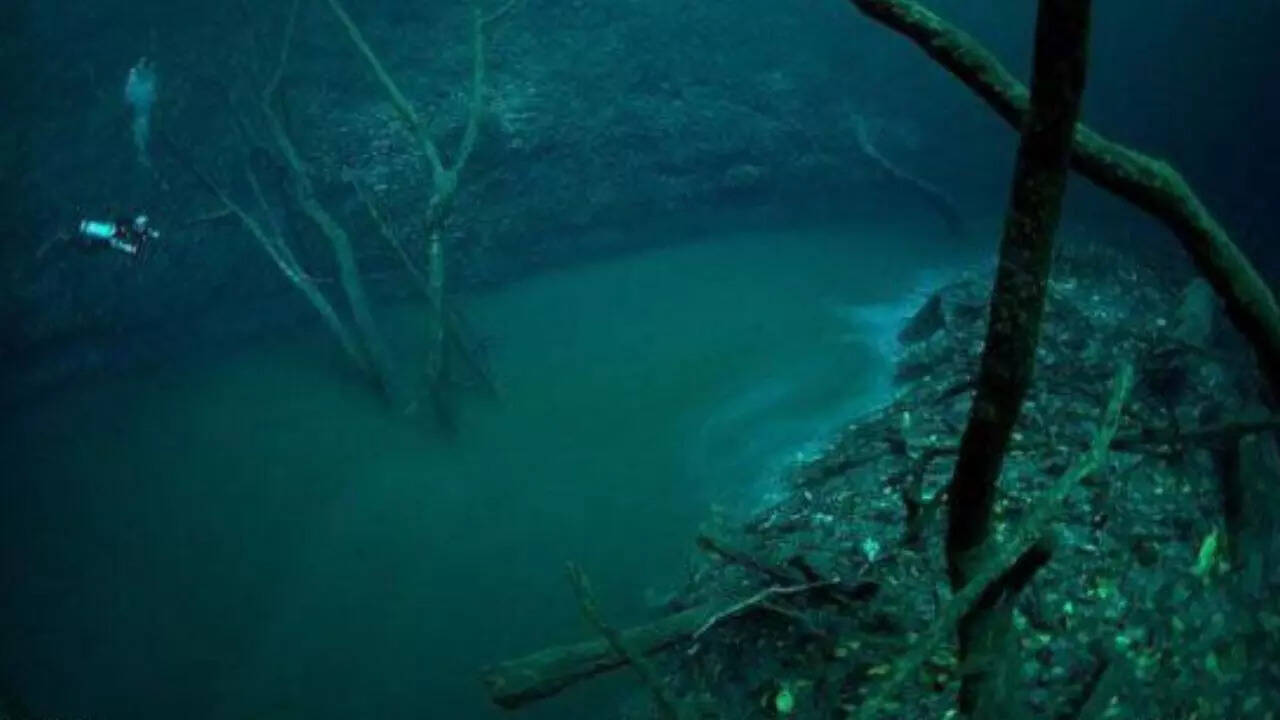
The surface of the Black Sea is a deceptive sheet of glass. To a sailor crossing from Istanbul to Odessa, the water appears as a vast, dark basin, heavy with salt and history. It is a graveyard of ancient shipwrecks, preserved for centuries in an oxygen-free embrace. But beneath the keel of that ship, far below the reach of any swimmer, a violent ghost is screaming through the dark.
It is a river.
If this river flowed across the surface of the land, it would be the sixth largest on the planet by volume. It carries 350 times the amount of water found in the Thames. Yet, no one can see it. No birds dive into its currents. No trees line its banks. It is a colossal, underwater torrent of brine, carving canyons into the sea floor with the same relentless architectural power as the Colorado River cutting through the Grand Canyon.
We are used to the idea that the ocean is a stagnant pool, a big tank of water that sloshes around with the tides. That is a comforting lie. The reality is far more chaotic.
The Anatomy of a Ghost
Imagine standing on the abyssal plain, 115 feet below the surface. You are in total darkness. Suddenly, you feel a rush of pressure. This isn't just a current; it has structure. It has "banks" made of dense, silt-heavy water. It has rapids. It even has waterfalls that tumble over subterranean cliffs, plunging into the deeper trenches of the Black Sea basin.
Scientists from the University of Leeds discovered this anomaly using a robotic submarine, a yellow autonomous vehicle that braved the crushing depths to map what shouldn't exist. They found a flow of water that is roughly half a mile wide and several miles long.
The physics of it feels like a glitch in the matrix. Why doesn't this water just mix with the rest of the sea? The answer lies in the Bosporus Strait.
The Mediterranean is saltier and denser than the Black Sea. As that heavy, saline water pours through the narrow Bosporus, it doesn't just dilute. It sinks. It hits the floor of the Black Sea like a lead weight and begins to race downhill, fueled by gravity and its own massive density. It is a river within a sea, a liquid highway that refuses to blend in.
The Invisible Stakes of a Hidden Current
This is not just a geological curiosity for academics to argue over in journals. The existence of this river changes how we understand the very lungs of our planet.
The Black Sea is "meromictic," a fancy way of saying its layers don't mix. The top layer is where the life is. The bottom layer is an "anoxic" dead zone, filled with hydrogen sulfide and devoid of oxygen. It is a place where time stops. But this hidden river acts as a giant syringe. As it hurtles along the sea floor, it carries oxygen and nutrients from the upper world into the dead heart of the deep.
Think of it as a life-support system for a part of the world we thought was permanently deceased.
If these rivers exist here, they exist in the vast, unmapped plains of the Atlantic and the Pacific. They are the circulatory system of the Earth. They move heat, they move carbon, and they move the building blocks of life into the darkest corners of the globe. If we don't account for them, our climate models are nothing more than educated guesses. We are trying to predict the weather of a house while ignoring the massive, roaring furnace in the basement.
A Journey into the Anoxic Deep
Consider a hypothetical explorer—let's call him Elias. Elias is a marine biologist who has spent his life studying the "Dead Zone" of the Black Sea. To him, the water below 150 meters has always been a wall. It is toxic. It is silent.
But then, he sees the data from the autonomous sub. He sees that in the middle of this toxic wasteland, there is a pulse.
"It’s like finding a vein in a limb you thought was withered," Elias might say.
He watches the sonar readouts. He sees the "meanders"—the S-shaped curves that rivers make as they erode the earth. On land, these curves are formed by the path of least resistance through soil and rock. Under the sea, they are formed by the complex dance of salinity and pressure.
Elias realizes that the sea floor isn't a flat, sandy desert. It is a landscape of high-speed transit. This river moves at speeds that would make a surface swimmer struggle. It carries sediments that act like sandpaper, grinding down the seabed and creating its own valleys.
Why This Matters to You
It is easy to look at a discovery 115 feet underwater and think: So what? The "so what" is the fragility of the balance. Our oceans are the primary regulators of the Earth's temperature. They absorb the vast majority of the heat we produce. But that heat isn't distributed evenly. It is moved by currents. If the "rivers" of the deep change their course—if the salinity of the Mediterranean shifts due to evaporation or if the Black Sea warms—the pump could fail.
When a river on land dries up, we see the cracked mud. We see the dying crops. When an underwater river stops, we see nothing. The surface remains a deceptive sheet of glass. But the deep-sea circulation stutters. The oxygen stops flowing to the abyss. The "lungs" of the ocean begin to fail.
We are currently mapping the surface of Mars with more precision than we are mapping the floor of our own oceans. We know more about the craters on the moon than we do about the sixth largest river on our own planet.
This hidden torrent is a reminder of our own ignorance. We live on a planet that is 70% water, yet we behave as if the land is the only thing that matters. We walk over the surface of secrets, unaware that beneath us, trillions of gallons of brine are carving a new world in the dark.
The robotic sub eventually returned to the surface, its sensors caked with the salt of the deep. It brought back a map of a place no human eyes will ever see firsthand. It showed us that even in the most hostile, toxic environments on Earth, there is movement. There is a flow.
There is a river that never sees the sun, and it is breathing life into the dark.
The next time you stand on a beach and look out at the horizon, remember that the water isn't just sitting there. Somewhere, miles out and deep down, a canyon is being carved. A waterfall is plunging into an abyss. A river is roaring through the silence, and the Earth is pulse-pounding with a hidden, heavy heart.
Would you like me to find the specific coordinates of the Bosporus undersea river or explain the chemical composition of the Black Sea's anoxic layer?