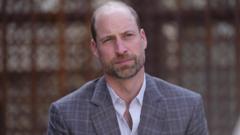
The British press loves a "rebranding" narrative. It is the oldest trick in the public relations playbook: take a centuries-old, crumbling institution, wrap it in the language of "meaningful bonds" and "modern relevance," and hope the public doesn't notice the dry rot. The recent reports suggesting Prince William is "keen to build a strong and meaningful bond" with the Church of England aren't just predictable; they are a fundamental misreading of the cultural trajectory of the United Kingdom.
The Prince of Wales is reportedly preparing for his eventual role as Supreme Governor of the Church of England with a series of quiet meetings and a focus on "social impact." This is the lazy consensus. The assumption is that for the Monarchy to survive, it must shore up its traditional pillars.
They are wrong.
The most "meaningful" thing William could do for the future of the British state is to facilitate a clean, professional, and permanent divorce between the Crown and the Altar.
The Secular Reality check
We need to stop pretending Britain is a Christian nation in any functional sense. The 2021 Census data from the Office for National Statistics (ONS) wasn't a warning; it was an autopsy. For the first time in history, fewer than half of the population in England and Wales identify as Christian. The number of people ticking the "No Religion" box has surged to over 37%.
In this environment, a future King attempting to "strengthen ties" with a minority interest group isn't an act of leadership. It is a strategic blunder. It anchors a supposedly "modern" Monarchy to a demographic that is literally disappearing.
The Church of England is currently a ghost in the machine of the British state. It holds 26 reserved seats for bishops in the House of Lords—a legislative privilege that has no place in a 21st-century democracy. By doubling down on this "meaningful bond," William isn't modernizing the Monarchy; he is reinforcing an exclusionary structure that alienates the very "diverse Britain" he claims to represent.
The Social Impact Fallacy
The PR spin suggests William wants to pivot the relationship toward "community service" and "social cohesion." This sounds noble. It is also redundant.
I have spent years watching institutions try to justify their existence by pivoting to "social impact" when their primary product—in this case, theology—stops selling. When a business does this, we call it a "pivot of desperation." When the Church does it, we call it "outreach."
The reality is that secular charities, local councils, and non-religious community groups already do the heavy lifting of social welfare. The Church of England’s infrastructure is a burden, not an asset. It is a sprawling estate of Grade I listed buildings that are hemorrhaging cash for repairs while the pews sit empty.
If William wants to tackle homelessness or mental health, he doesn't need a "meaningful bond" with a Bishop. He needs a functional relationship with Treasury officials, housing experts, and private capital. Using the Church as a middleman for social progress is like using a rotary phone to launch a tech startup. It’s nostalgic, clunky, and wildly inefficient.
The Defender of Faiths Trap
There is a recurring argument, popularized by the late Queen and King Charles III, that the Monarch should be a "Defender of Faith" (singular) who acts as a "Protector of Faiths" (plural).
This is a logical trap.
By attempting to be the umbrella for all religions, the Monarchy creates a hierarchy where "Faith" is a prerequisite for being a truly "British" citizen. What about the 22 million people who have no faith? In his rush to look inclusive to minority religions, William risks making the largest and fastest-growing demographic in the country—the secularists—feel like second-class subjects.
True inclusivity in 2026 isn't about the King nodding to a Rabbi, an Imam, and a Priest. True inclusivity is Disestablishment.
The Institutional Cost of Loyalty
Let’s talk about the "battle scars" of institutional survival. I’ve seen legacy brands cling to "traditional partnerships" right up until the moment they go bankrupt. They fear that if they drop the old guard, they will lose their soul.
The Monarchy fears that if it severs ties with the Church, it loses its "mystique" and its divine mandate. But the "divine right of kings" died with Charles I. The modern Monarchy’s only mandate is "utility."
Every time the Church of England gets embroiled in a scandal—whether it's the handling of internal abuse reports or the bitter, protracted civil wars over sexuality and gender—the Crown gets splashed with the mud. By maintaining this "meaningful bond," William is essentially signing a joint-liability contract with a volatile partner.
Why would a "sharp, modernizing" leader want to be the CEO of a company that is legally tethered to a failing subsidiary?
A Radical Proposal for the Future King
If William actually wants to be a "Game-Changer" (a term I loathe, but one his PR team clearly loves), he should do the following:
- Request Disestablishment: He should signal to Parliament that he is willing to forgo the title of Supreme Governor. This would trigger a constitutional shift that would allow the Church to be truly independent and the Monarchy to be truly representative.
- Repurpose the Estate: Instead of "meaningful bonds" with clergy, he should advocate for the "meaningful conversion" of redundant Church assets. Imagine those empty, heated-but-hollow cathedrals as community tech hubs, shelters, or secular art spaces that aren't governed by 16th-century canon law.
- A Secular Coronation: When his time comes, he should strip the ceremony of its heavy-handed Anglican liturgy. Make it a constitutional oath to the people, not a mystical anointing by a priest.
The "nuance" the competitors miss is that William’s survival depends on his ability to be a "Citizen King," not a "Sacred King."
The public’s affection for the Monarchy is currently based on a sense of stability and service. Neither of those things requires a connection to a religious institution that the vast majority of the public no longer attends or understands.
The risk of this contrarian approach is obvious: it might offend the traditionalist base. But that base is aging out. The reward is a Monarchy that is finally, for the first time in 500 years, culturally aligned with the people it reigns over.
Stop trying to fix the Church-State alliance. It’s a relic.
William should stop trying to build a bridge to a sinking island. He should be the one who finally cuts the rope.
Move the Monarchy into the light of the 21st century. Leave the incense and the empty pews behind.