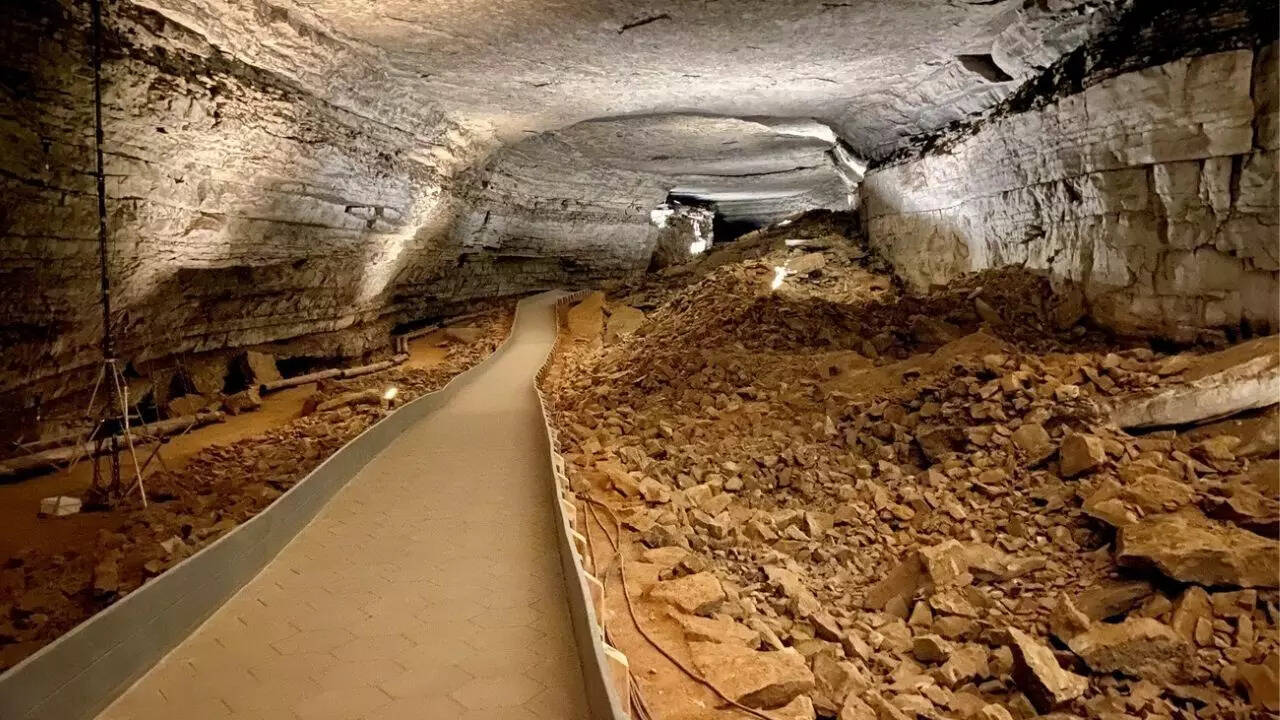
Kentucky sits on a ticking geological clock that most people never think about. While we walk around on the surface, a massive, silent expansion happens right under our feet. Mammoth Cave isn't just a big hole in the ground. It's a 686-kilometer labyrinth that keeps getting longer every time a surveyor squeezes through a tight, muddy gap.
If you think we've found everything there is to find down there, you're wrong. Most visitors see the grand, electric-lit Rotunda or the high ceilings of Broadway, but the real story of Mammoth Cave is in the "tight spots." It’s in the grueling, multi-hour crawls that lead to brand-new cathedrals of stone. Scientists and volunteers with the Cave Research Foundation (CRF) add miles to the map every year. They aren't just looking for open spaces. They're documenting a living, breathing drainage system that has been carving through limestone for millions of years.
The sheer scale is hard to wrap your head around. If you took the next two longest caves in the world and tied them together, Mammoth Cave would still be longer. It’s a subterranean empire.
The Secret Strength of the Sandstone Cap
Why is this cave here and not in, say, Ohio or Tennessee? It comes down to a very specific geological sandwich. Most caves are vulnerable. If the ceiling gets too thin, they collapse and become sinkholes or canyons. Mammoth Cave survived because of a "caprock" of Big Clifty Sandstone.
Think of this sandstone as an umbrella. It's hard, durable, and mostly waterproof. Underneath it lies hundreds of feet of Saint Louis Limestone and Ste. Genevieve Limestone. These are the soft bits. When rainwater picks up carbon dioxide from the soil, it becomes a weak acid. This acid eats away at the limestone, but the sandstone roof stays solid.
This creates a protected environment where the cave can grow for miles without the roof caving in. In areas where the sandstone cap is missing, you see massive sinkholes. These are the "skylights" of the system, like Cedar Sink, where you can see the underground rivers briefly touch the surface before diving back into the dark.
How We Keep Finding More Miles
People always ask how a cave "grows" 686 kilometers. It doesn't actually grow in real-time—at least not fast enough for us to notice. We just get better at finding the connections. For decades, the Flint Ridge Cave System and Mammoth Cave were thought to be separate. In 1972, a team led by Patricia Crowther crawled through a wet, narrow passage called the Tight Spot. They found the connection. Overnight, the map exploded in size.
Mapping this place is a nightmare. You're dealing with 100% humidity, 54-degree temperatures, and total darkness. Modern surveyors use laser rangefinders and specialized software, but the physical work is still the same as it was in the 1800s. You have to be willing to slide on your belly through "The Digestive Tract" or "The Agony."
I've talked to researchers who spend 12 hours underground just to map 50 feet of new passage. It sounds insane. Why do it? Because every new room tells us something about the hydrology of Kentucky. These passages are the plumbing for the entire region. If you dump chemicals on a farm ten miles away, that stuff shows up in the cave's Echo River within days.
Life in the Perpetual Dark
The biology inside Mammoth Cave is just as weird as the geology. Evolution takes a strange turn when you remove light from the equation. You have the Kentucky Cave Shrimp (Palaemonias ganteri), which is blind and nearly transparent. It doesn't need eyes. It needs sensors.
Then there are the eyeless fish and the cave crickets. These crickets are actually the "engine" of the cave's ecosystem. They leave the cave at night to eat and then return, bringing nutrients back in the form of waste. Without those crickets, the entire food chain in the deep cave would collapse. It's a fragile balance.
We often think of caves as dead zones. They aren't. They're high-stakes environments where one small change in water pH or temperature can wipe out a species that exists nowhere else on Earth. The National Park Service monitors these levels constantly, especially with the increase in regional development.
The Human Element and the Great Cave War
The history of this place is messy. In the 1920s, there was something called the "Kentucky Cave Wars." Landowners realized that caves were a goldmine for tourism. They would set up fake information booths, steer tourists away from "official" caves, and lie about which entrance led to the best views.
The most famous tragedy of this era was Floyd Collins. He got trapped in Sand Cave in 1925. The attempt to rescue him became one of the first major "media circus" events in American history. Thousands of people showed up. Vendors sold hot dogs near the cave entrance while Collins was dying underground. It was a grim reminder that as much as we love to explore these places, the earth doesn't care about our curiosity.
Eventually, the government stepped in. They consolidated the land to create the National Park in 1941. This stopped the "wars," but it didn't stop the exploration. We are still finding artifacts from the Native Americans who explored these passages 4,000 years ago. They went miles into the dark using nothing but bundles of burning cane for light. We find their discarded torches, their footprints, and even their burial sites. It’s a time capsule.
What You Should Actually Do When You Visit
If you're planning to go, don't just book the first tour you see on the website. Most people do the "Historic Tour" and call it a day. That's a mistake.
If you are physically able, book the Wild Cave Tour. It’s the only way to understand what I’m talking about. You’ll be issued a jumpsuit, a helmet, and a headlamp. You will crawl. You will get muddy. You will realize how small you are when you’re 300 feet below the surface in a passage that hasn't changed in ten thousand years.
For those who want the science without the claustrophobia, the Domes and Dripstones Tour is the best bet. You get to see the "New Entrance" sections where the water is still actively forming stalactites and stalagmites. It's a contrast to the dry, dusty sections of the historic entrance.
Check the weather before you go. Heavy rain can cause some lower-level tours to be canceled because the Green River rises and floods the cave's bottom passages. This is a living system. It reacts to the world above.
Stop by the White Lightning or the Snowball Room if you can. Seeing a cafeteria built into a limestone cavern is a weirdly Mid-Century American experience that you won't find anywhere else. But remember, the cave is the star, not the snacks.
Buy your tickets months in advance. I'm serious. They sell out fast, especially in the summer. If you show up at the Visitor Center at noon on a Saturday without a reservation, you’re going to be disappointed. Head to the Green River Ferry nearby while you wait for your slot. It's one of the last river ferries in the state and gives you a great look at the water that actually built the cave.
Go deep. Get dirty. Respect the dark.