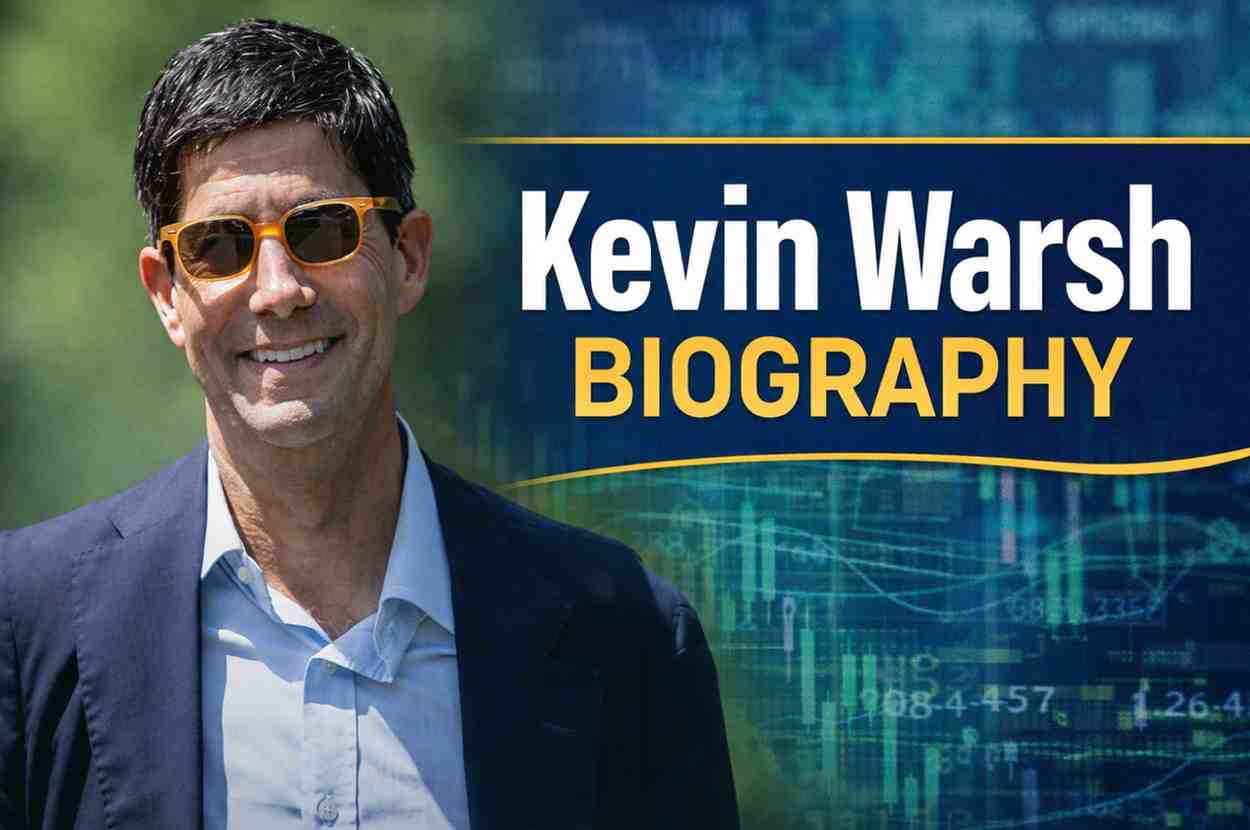
The financial press is currently obsessed with the idea that Kevin Warsh is walking into an economic "perfect storm." They point to sticky inflation, a ballooning deficit, and a volatile labor market as if these are external acts of God that Warsh must somehow navigate.
They have it backward.
The storm isn't something Warsh has to survive. The storm is the direct result of the Federal Reserve’s own institutional rot. For a decade, the Fed has operated on the delusional belief that they can "fine-tune" a $27 trillion economy like a thermostat. Warsh isn't being sent in to be a meteorologist; he’s being sent in to be an oncologist.
The "lazy consensus" suggests that Warsh’s biggest challenge is managing a soft landing. That’s a fantasy. There is no soft landing when you’ve spent years inflating asset bubbles with zero-interest-rate policy (ZIRP) and quantitative easing. The real challenge—the one nobody in Washington wants to talk about—is whether Warsh has the spine to strip the Fed of its god complex and return it to its original, narrow mandate.
The Myth of the Neutral Rate
Economists love to debate $r^*$, the so-called "neutral" interest rate where the economy neither expands nor contracts. It’s a ghost. It’s a theoretical variable that cannot be observed in real-time, yet the current Fed treats it like a North Star.
When the media says Warsh faces a "difficult balancing act," they mean he has to guess where this invisible rate is. But the premise is flawed. By trying to find a "neutral" rate, the Fed creates massive distortions. If they guess too low, they fuel speculation in crypto and tech unicorns. If they guess too high, they crush small businesses.
Warsh understands something his predecessors ignored: the market should discover the price of money, not a committee of Ph.Ds in a windowless room. The obsession with "forward guidance"—telling the market exactly what the Fed will do for the next six months—has turned Wall Street into a group of pampered infants who scream the moment the liquidity pacifier is pulled away.
Quantitative Easing was a Drug, Not a Cure
We are told that the Fed’s massive balance sheet expansion saved the global economy. I’ve watched traders make fortunes not by betting on companies, but by betting on the Fed’s printing press. That isn’t capitalism; it’s state-sponsored gambling.
The balance sheet currently sits at roughly $7 trillion. The "perfect storm" narrative suggests Warsh must be careful about shrinking it to avoid a "taper tantrum."
Let the tantrum happen.
The fear of market volatility has paralyzed the Fed. Every time the S&P 500 drops 5%, the Eccles Building panics. Warsh’s background at Morgan Stanley and his time on the Board during the 2008 crisis gave him a front-row seat to the carnage. He knows that by preventing small fires, the Fed is simply piling up dry brush for a massive forest fire.
The contrarian truth is that we need a period of sustained "boring" monetary policy. No more emergency interventions. No more "transitory" lies. No more trying to solve social inequality or climate change with interest rate hikes. Those are tasks for Congress, and the Fed’s attempt to mission-creep into those areas has destroyed its credibility.
The Fiscal Dominance Trap
The most legitimate threat Warsh faces isn't inflation—it’s "fiscal dominance." This occurs when the government’s debt is so high that the central bank is forced to keep interest rates low just so the Treasury can afford the interest payments.
The US is currently spending over $1 trillion a year just on interest. If Warsh raises rates to fight inflation, he makes the deficit worse. If he lowers rates to help the Treasury, he lets inflation run wild.
The consensus view is that Warsh will have to "coordinate" with the Treasury. That’s a polite way of saying "surrender independence."
A truly "sharp" chair would do the opposite. Warsh should publicly dare the Treasury to fix its own house. The Fed’s job is price stability, not being the piggy bank for congressional overspending. If the government’s check bounces because rates are at 5%, that is a fiscal failure, not a monetary one. By constantly bailing out the Treasury, the Fed has removed all incentive for fiscal discipline in D.C.
Why the "Data-Dependent" Mantra is a Lie
If you hear a Fed official say they are "data-dependent," what they are actually saying is, "We have no idea what we’re doing, so we’re looking in the rearview mirror."
Economic data—CPI, non-farm payrolls, GDP—is lagging. It tells you what happened last month or last quarter. Using it to set policy for next year is like trying to drive a car while looking only at the backup camera.
Warsh has signaled a preference for market-based signals over bureaucratic data. Gold prices, credit spreads, and the shape of the yield curve are real-time indicators of what people are actually doing with their money. The "experts" hate this because it reduces their power. If the market is the guide, you don't need 400 economists to build models that are consistently wrong.
The Ghost of Paul Volcker
Everyone wants to be Paul Volcker until it’s time to do Volcker things.
The media compares the current environment to the 1970s. They say Warsh needs to be "tough." But they don't actually want him to be tough. They want him to be "predictable."
True toughness means being willing to be the most hated man in America for two years. It means ignoring the tweets from the White House and the frantic calls from hedge fund managers.
Warsh’s critics claim he is too "hawkish" or too "political." These are code words for "he might actually change things." The status quo loves a chair who speaks in "Fedspeak"—that garbled, intentional ambiguity designed to say nothing while sounding profound. Warsh is prone to speaking clearly. In the world of central banking, clarity is a revolutionary act.
Breaking the "Fed Put"
For thirty years, the "Fed Put" has been the underlying assumption of every investment strategy. The belief is that if things get bad enough, the Fed will always step in to save the markets.
This has created a moral hazard of epic proportions. It’s why we see "zombie companies" that shouldn't exist still trading on the NYSE. It’s why housing prices are decoupled from reality.
If Warsh wants to actually fix the economy, he has to kill the Fed Put. He has to look a crashing market in the eye and say, "Not my job."
Is there a risk? Of course. The risk is a massive deleveraging event. But the alternative is a slow, agonizing decline into a stagflationary trap where the US dollar loses its status as the world’s reserve currency.
The Wrong Question
People are asking: "Can Kevin Warsh handle the storm?"
The real question is: "Will Kevin Warsh let the storm blow out the dead wood?"
The Federal Reserve has spent too long trying to prevent the natural cycles of the economy. They’ve tried to outlaw the recession. But recessions are necessary. They are the market’s way of cleaning out bad investments and inefficient companies. By trying to avoid a "perfect storm," the Fed has created a permanent fog.
Warsh shouldn't try to be a hero who saves the day with a clever new policy tool. He should be the guy who turns off the machine and lets the market breathe again.
Stop looking for a pilot who can fly through the hurricane. Look for the guy who is willing to land the plane and admit that the engines are failing because we kept pouring cheap liquidity into the fuel tank.
The era of the "Rock Star" Central Banker needs to die. If Kevin Warsh is as smart as he thinks he is, he will make himself the most boring, invisible, and uncooperative Fed Chair in history.
That is the only way to save the dollar. Everything else is just noise.