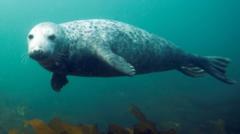
The image of the grey seal as a clumsy, doe-eyed inhabitant of the British coastline is dead. In its place is a highly efficient, warm-blooded predator that has recently crossed a grim threshold in Welsh waters. For the first time, researchers have documented a grey seal predating a harbor dolphin off the coast of Anglesey. This isn’t a freak accident or a case of mistaken identity. It is a calculated behavioral shift that signals a fundamental reorganization of the North Sea and Irish Sea food chains.
For decades, we viewed these animals as specialized fish-eaters. Marine biology textbooks largely confined their diet to sand eels, cod, and various crustaceans. But the discovery of a mutilated harbor porpoise—and now the first confirmed dolphin kill in Wales—proves that grey seals are expanding their repertoire to include small cetaceans. They are moving up the ladder. This evolution in hunting strategy isn’t just a curiosity for academics; it’s a warning about the mounting pressure within our marine ecosystems.
The Myth of the Gentle Seal
We have spent too long anthropomorphizing marine mammals. To the average tourist on a coastal path, a seal is a "sea dog." To a harbor porpoise or a juvenile dolphin, it is increasingly becoming a nightmare. The mechanics of these attacks are gruesome and efficient. Grey seals don’t swallow these larger targets whole. They use their powerful claws and incredible jaw strength to grip the prey, often targeting the high-energy blubber around the neck and head.
The evidence gathered by strandings networks across the UK shows a pattern of "corkscrew" injuries—long, spiral lacerations once blamed on boat propellers. We now know better. These are the marks of a seal holding on for dear life while its prey tries to spin away. In the recent Welsh case, the necropsy of the dolphin revealed bite marks and trauma consistent with a massive force applied to the dorsal area. The seal isn't just killing for sport; it is seeking the highest caloric return for its effort.
Why the Shift is Happening Now
Nature rarely changes its playbook without a push. The "why" behind this predatory pivot likely boils down to a combination of population density and resource scarcity. The UK is home to roughly 40% of the world’s grey seal population. In places like the Monach Isles or the Farne Islands, colonies are bursting at the seams. When a population hits a certain ceiling, competition for traditional food sources like sand eels becomes fierce.
- Caloric Density: A single harbor porpoise or small dolphin provides a massive energy windfall compared to chasing thousands of tiny fish.
- Learning and Mimicry: Seals are highly intelligent. Once one "specialist" bull seal learns how to take down a mammal, others observe and replicate the behavior.
- Environmental Shifts: Changing sea temperatures are pushing traditional fish stocks further north, forcing seals to look at what's left behind.
The Forensics of a Kill
When a dead dolphin washes up on a Welsh beach, the investigation is as meticulous as any crime scene. Scientists from the UK Cetacean Strandings Investigation Programme (CSIP) look for specific markers that differentiate a seal attack from a shark bite or a boat strike.
Grey seals have a specific "grip and tear" method. They lack the serrated teeth of a Great White, so they rely on raw crushing power and their foreflippers to strip skin and blubber. This leaves behind jagged edges and significant internal bruising that speaks to a violent struggle. In the Anglesey incident, the precision of the feeding suggested an experienced hunter. This wasn't a desperate pup trying its luck; it was an apex predator at the height of its powers.
We have to move past the shock of the "killer seal" headline and look at the biological reality. Predators adapt. If the ocean's basement is empty, they start eating the neighbors on the first floor.
The Impact on Conservation Strategy
This discovery throws a wrench into current conservation models. For years, the focus in Wales has been on protecting harbor porpoises and dolphins from human interference—by-catch in fishing nets, noise pollution from shipping, and plastic ingestion. While those remain massive threats, we now have to account for a "natural" predator that is protected by the same laws as its prey.
The Grey Seal is a protected species under the Conservation of Seals Act 1970. We have done an incredible job of bringing them back from the brink of extinction. However, we are now entering a phase where one protected species is actively decimating another in localized areas.
This creates a policy paradox. Do we intervene? Should we manage seal populations to protect the rarer harbor porpoise? Most experts say no. The "hands-off" approach is generally favored, but as these attacks become more common and more visible to the public, the pressure to "do something" will mount. This is the reality of a recovering ecosystem; it gets bloody.
The Geography of the New Hunt
While the Welsh dolphin kill is the latest milestone, this behavior has been creeping south for a decade. It began with "The Cannibal of Helgoland"—a male grey seal in the German North Sea documented killing and eating its own kind. Then came the porpoise kills in Norfolk and Scotland. The move into Welsh waters suggests that the "culture" of mammal-eating has successfully migrated through the seal populations of the Irish Sea.
- The East Coast: High frequency of porpoise predation.
- The Isle of Man: Increasing reports of aggressive interactions.
- Anglesey and Pembrokeshire: The new frontier for dolphin predation.
Managing Public Perception
The biggest challenge isn't the biological shift itself, but how we talk about it. There is a risk of demonizing grey seals, turning them into villains in a narrative they didn't ask to join. They are simply responding to the environment we have shaped. Overfishing of smaller prey species has made the "mammal-eating" strategy viable, if not necessary.
We also have to consider the safety of humans. While there have been no documented "predatory" attacks on swimmers in the UK, a seal that views a 50kg dolphin as a meal is an animal that deserves extreme distance. Their lack of fear is growing. In popular tourist spots in West Wales, seals are becoming increasingly bold around piers and boats, habituated by well-meaning people throwing them fish scraps. We are teaching a massive carnivore that humans equal food, right at the same time they are learning how to hunt large mammals.
The Economic Ripple Effect
Wildlife tourism is a massive driver for the Welsh coastal economy. Thousands of people take boat trips every year specifically to see "friendly" seals and dolphins. If the spectacle changes from a peaceful coexistence to a National Geographic-style kill zone, the marketing needs to change. Tourists aren't always prepared for the raw reality of nature.
Moreover, the fishing industry, which has long had a contentious relationship with seals, will likely use these predatory shifts as leverage to demand culls. They will argue that if seals are "out of balance" enough to be eating dolphins, they are certainly eating too many commercial fish. It is a messy, multi-layered conflict with no easy exit.
The Hidden Cost of Success
The rise of the predatory grey seal is, ironically, a sign of a successful conservation era. We protected them, and they thrived. But nature doesn't stop at a "feel-good" population number. It continues to expand until it hits a wall, and that wall is usually made of blood and bone.
We are watching a species re-learn its role as a top-tier hunter. It is a fascinating, if brutal, display of evolutionary plasticity. The harbor dolphin of Wales is the latest victim, but it won't be the last. As we move forward, our monitoring of these populations can't just be about counting heads; it has to be about tracking behavior.
The ocean is not a static gallery. It is a theater of constant, often violent, adaptation. The grey seal has reminded us that it doesn't care about our labels of "cute" or "vulnerable." It is a predator, it is hungry, and it has found a new way to survive in a changing sea.
Respect the distance. Acknowledge the change. The era of the sea dog is over; the era of the coastal wolf has begun.