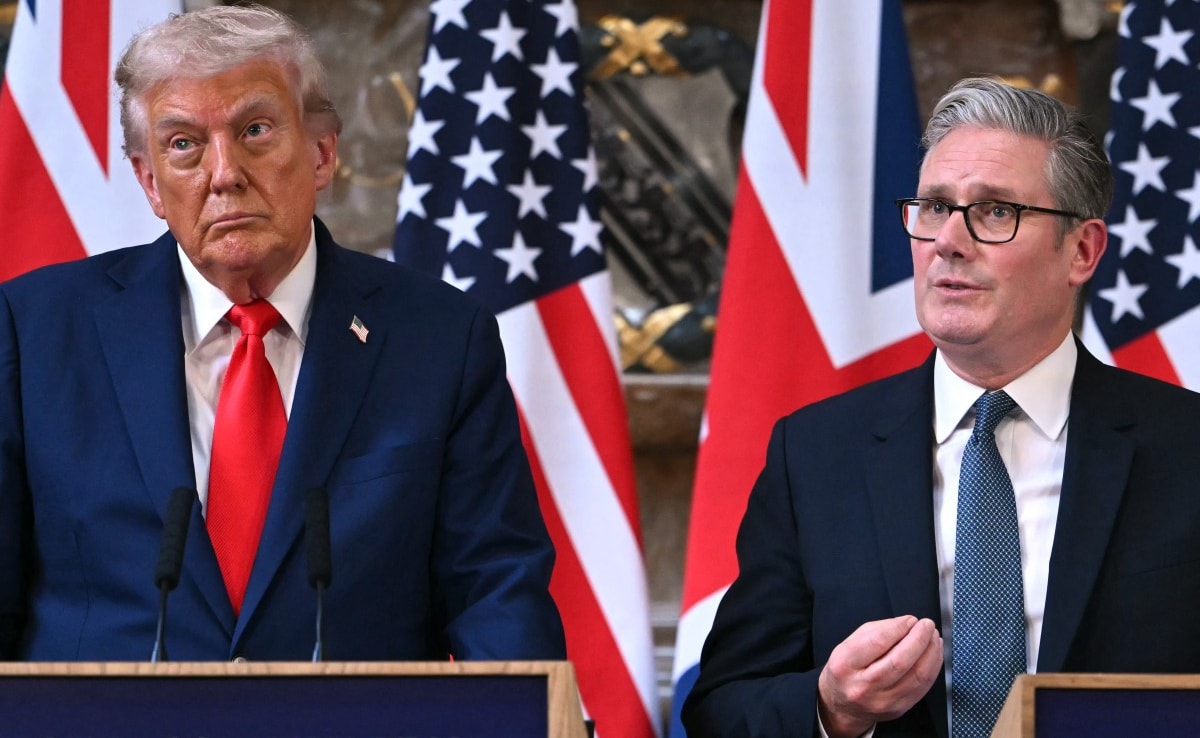
The recent diplomatic friction between the United States and the United Kingdom regarding access to Diego Garcia and domestic RAF facilities reveals a fundamental misalignment in modern alliance management. When President Donald Trump expressed "very disappointed" sentiments regarding Prime Minister Keir Starmer’s initial hesitation to authorize offensive strikes from these locations, the discourse centered on interpersonal political dynamics. However, the root cause is a structural evolution in the cost-benefit calculus of military hosting. The following breakdown deconstructs why the "special relationship" is currently experiencing a divergence in operational risk assessment.
The Triad of Strategic Friction
Modern military alliances are no longer defined solely by ideological alignment. They are governed by three competing variables that define the willingness of a host nation to permit kinetic operations:
- Legal Jeopardy and International Standing: The British government’s hesitation, cited in reports as a concern over the legality of participating in strikes without explicit international consensus, is a manifestation of institutional risk aversion. Modern legal frameworks often blur the line between "hosting" and "participating." For a host, the risk is not just political blowback, but potential liability in international forums.
- Operational Sovereignty vs. Interdependence: The United Kingdom has increasingly sought to define its own strategic path, exemplified by the 2025 sovereignty agreement concerning the Chagos Archipelago. By moving toward a leasehold model, the UK attempted to create a firewall between its long-term territorial control and short-term operational usage. The conflict occurs when this leasehold model is tested by the realities of a kinetic theater where the US requires immediate, unrestricted access.
- Targeted Retaliation Dynamics: The strike on the RAF base in Cyprus serves as a case study for the risks host nations now calculate. Unlike the Cold War era, where host bases were largely shielded from direct peer-state retaliation, modern missile and drone proliferation places domestic infrastructure at immediate, measurable risk. The British calculation is no longer "Will we support our ally?" but "Can we afford the kinetic cost of that support on our own soil?"
The Cost Function of Host Nation Consent
To understand why authorization was initially delayed, one must view the decision through the lens of a domestic "Cost Function" $(C)$.
$$C_{total} = C_{diplomatic} + C_{kinetic} + C_{legal}$$
- $C_{diplomatic}$: The cost of public and parliamentary pushback if the government is seen as a "junior partner" in a foreign-initiated conflict.
- $C_{kinetic}$: The probability and impact of retaliatory strikes on UK facilities (e.g., the Cyprus drone incident).
- $C_{legal}$: The political and judicial fallout from violating international norms or domestic legislative oversight.
The US operational model prioritizes speed and tactical dominance, which assumes a high degree of host-nation permissiveness. When a host nation’s $C_{total}$ exceeds their perceived strategic benefit, the result is friction. The delay described by the White House was not necessarily a lack of political will, but the time required to manage the $C_{legal}$ and $C_{kinetic}$ components of this equation.
Strategic Implications for Power Projection
The reliance of the United States on British-managed infrastructure, specifically the "hub-and-spoke" model where US force is projected through UK-hosted logistical nodes, is becoming a bottleneck. This creates two distinct strategic outcomes:
- Operational Decoupling: Planners must now account for "denied access" scenarios even among closest allies. This necessitates the development of more self-sustaining, carrier-based, or long-range strike capabilities that do not rely on fixed foreign airfields.
- Negotiated Access Costs: Future military hosting agreements will likely transition away from blanket usage rights toward transactional, operation-specific authorization protocols. This move toward "conditional access" provides the host nation with a veto mechanism at every stage of the escalation ladder.
The Shift Toward Contingent Alliance
The assumption that the UK would act as a force multiplier for American power projection by default has been shattered. The shift on March 1, 2026, where the UK allowed limited defensive use, demonstrates that the "special relationship" has morphed from an unconditional strategic partnership into a contingent one.
The immediate requirement for the United States is to re-evaluate the risk profile of its forward-deployed bomber fleets. Relying on RAF Fairford or Diego Garcia in scenarios where the mission parameters might oscillate between "defensive" and "regime change" risks operational paralysis.
Moving forward, the primary strategic play for Washington is to formalize an "Operational Access Framework" with the UK that moves beyond case-by-case political vetting. This requires pre-defining "red-line" scenarios where access is granted automatically in exchange for hardened defense guarantees for the host facilities. Without this, the United States faces a perpetual risk of operational delay whenever its global interests conflict with the domestic legal and security sensitivities of its most critical partners.


