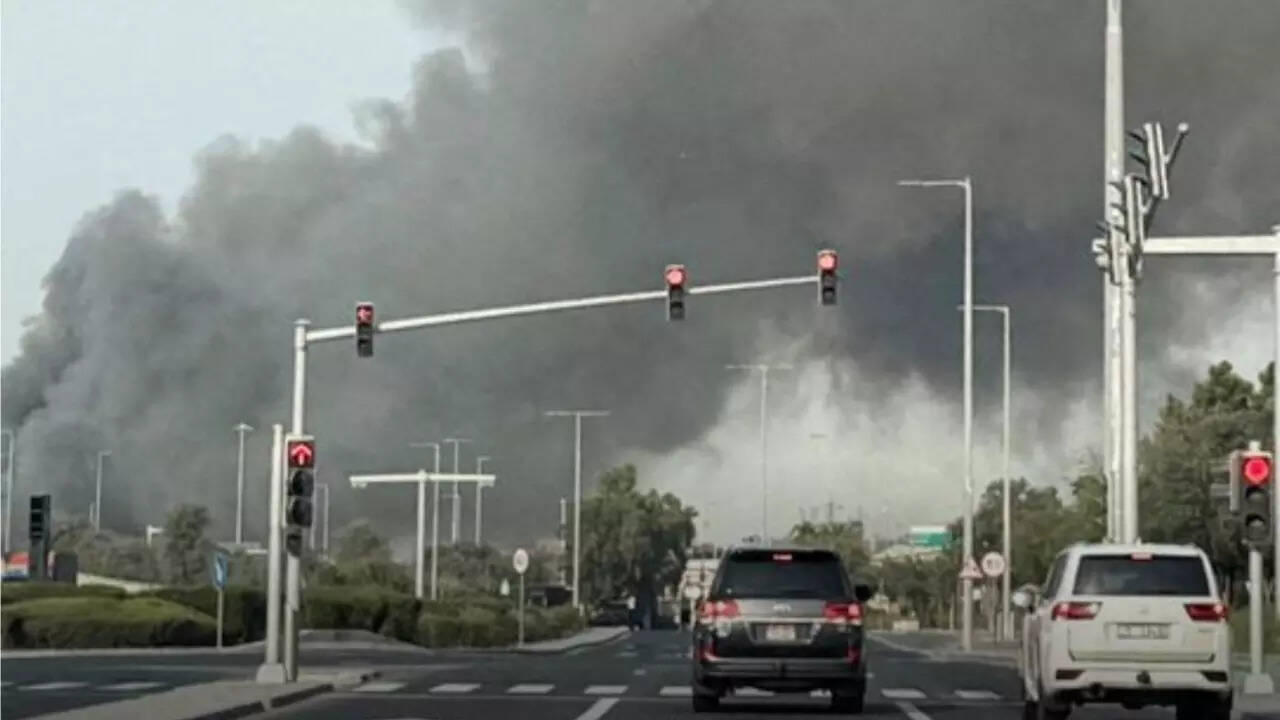
The headlines are screaming about a regional apocalypse. They want you to believe that a single missile hitting a car in Abu Dhabi is the opening bell for World War III. They want you to think the UAE is "on alert" because of a sudden, inexplicable escalation in the Iran-Israel shadow war.
They are wrong.
The media is obsessed with the "who" and the "where." They are completely ignoring the "how" and the "why." If you think this is just another chapter in a decades-old religious or geopolitical grudge, you aren't paying attention to the hardware. You are watching a kinetic tragedy through a 20th-century lens while the actual conflict is being fought with 21st-century logistics.
The Fallacy of the Strategic Strike
The competitor narrative suggests this was a calculated move to draw the United States into a direct confrontation. That is lazy thinking. I have spent years analyzing regional defense procurement, and if there is one thing that becomes clear when you look at the debris, it’s that these strikes are rarely about "winning" a war. They are about testing the market.
We call it "Battle Lab Diplomacy."
Regional proxies aren't just firing missiles to kill; they are firing them to see which interceptor systems fail. When a civilian car is hit in a city as heavily defended as Abu Dhabi, the story isn't the tragedy of the victim—though the loss of life is undeniable. The story is the catastrophic failure of multi-billion dollar integrated air defense layers.
Abu Dhabi is arguably one of the most surveilled and protected patches of dirt on the planet. If a low-slow loitering munition or a ballistic fragment can find its way onto a highway, we aren't looking at a "war escalation." We are looking at a product recall for the entire Western defense industry.
Stop Asking if Iran Did It
People also ask: "Is Iran behind the Abu Dhabi attack?"
That is the wrong question. It assumes a top-down, command-and-control structure that hasn't existed in the Middle East for a decade. The democratization of precision-guided munitions means that "attribution" is a ghost.
The real question is: "Who provided the telemetry?"
You don't need a state-sponsored missile program to hit a target in the UAE anymore. You need a commercial drone, a 3D printer, and a stolen GPS spoofing algorithm. By focusing on "Iran vs. Israel," the mainstream press misses the rise of the Non-State Tech Hegemon. These are groups that operate with the budget of a startup but the lethality of a mid-sized European army.
I’ve seen intelligence reports where the "missile" in question was actually a patchwork of off-the-shelf components that bypassed radar because it had the cross-section of a large bird. When you treat this as a conventional military threat, you lose. You are trying to swat a swarm of bees with a sledgehammer.
The UAE is Not "On Alert" — It Is Rebranding
The "on alert" narrative is a favorite for journalists who need to sell urgency. In reality, the UAE’s response is a masterclass in risk management, not military panic.
The Emirates do not function like a traditional nation-state; they function like a global logistics hub. Their primary concern isn't a border invasion; it’s the insurance premiums at Jebel Ali port.
- The Insurance Reality: If the UAE appears "unstable," the cost of shipping rises.
- The Tourism Factor: If headlines say "War," the hotels in Dubai empty.
- The Energy Pivot: If the Strait of Hormuz looks shaky, the push for nuclear and solar becomes a survival necessity, not a green initiative.
The "alert" status is a signal to Washington and London to provide better kinetic insurance. It’s a negotiation tactic. The UAE is saying, "We bought your THAAD systems, we bought your Raptors, and yet a car just exploded in our capital. Fix the software, or we start buying from Beijing."
The Myth of the "Surgical" Response
The consensus says that Israel or the US will respond with "surgical strikes" to restore deterrence.
There is no such thing as a surgical strike in a world of asymmetric hardware. Every time a Western power drops a $2 million bomb on a $50,000 drone factory, the enemy wins the economic war.
Consider the math:
- Enemy Cost: $15,000 for a suicide drone.
- Interceptor Cost: $2,100,000 for a single PAC-3 missile.
- The Result: You can bankrupt a superpower without ever winning a single dogfight.
The "status quo" of deterrence is dead. We are entering an era of Attritional Defiance. The goal of these missile strikes isn't to conquer Abu Dhabi. It’s to make the cost of defending Abu Dhabi so high that the US eventually decides the "tapestry" of its alliances (to use a word I despise) isn't worth the bill.
Why the "Proxy War" Label is Dangerous
Calling this a proxy war suggests that the groups on the ground are puppets. They aren't. They are contractors.
In the modern Middle East, loyalty is a commodity. If you think the Houthi rebels or various militias are just doing Tehran’s bidding, you are ignoring their local agendas. These groups use Iranian tech to settle local scores, often to the surprise and chagrin of their benefactors.
The danger of this missile hit isn't that it starts a war between two giants. The danger is that it proves small players can hijack the global economy by hitting a single GPS coordinate.
The Hidden Failure of Intelligence
We have more satellites over the Gulf than there are stars visible to the naked eye. Yet, we "didn't see it coming."
This isn't an intelligence failure; it's a processing failure. We are drowning in data but starving for insight. We are looking for "launch signatures" when we should be looking for "component shipments."
I have watched defense contractors blow millions on AI-driven threat detection that can't tell the difference between a cooling tower and a launch pad under the right atmospheric conditions. The hardware is fine. The logic is broken.
The Brutal Truth About Stability
The media wants a villain. They want a clear line between the "good guys" and the "bad guys."
The truth is that everyone in this theater is playing a double game. The UAE trades with Iran while buying missiles to shoot down Iranian-made drones. Israel coordinates with Russia while bombing Russian-protected assets in Syria. The US provides "security" while pivoting its actual resources to the South China Sea.
This missile strike is a reminder that the "Shield" is a lie. There is no absolute security in a globalized world. There is only "acceptable risk."
If you are waiting for a "return to normalcy," you are going to be waiting forever. This is the new normal. Kinetic incidents in high-luxury zones are the price of doing business in a multipolar world.
The next time you see a headline about a missile in the Middle East, don't look at the explosion. Look at the stock prices of the companies making the interceptors. Look at the shipping routes. Look at the quiet meetings in Beijing that happen three days later.
Stop looking for a war. Start looking for the audit.
The missile didn't hit a car. It hit the illusion that money can buy 100% immunity from the chaos of a collapsing regional order.
Build a better bunker, or get a better map. The one you’re using is decades out of date.