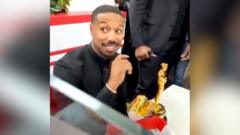
When Michael B. Jordan clutched an Oscar and then immediately headed for a drive-thru window, he wasn't just hungry. He was executing a calculated maneuver in the high-stakes theater of celebrity branding. The image of a tuxedo-clad A-lister balancing a Double-Double on their lap in a limousine has become the definitive "after-after-party" ritual. It serves as a necessary antidote to the perceived stuffiness of the Academy Awards, a way for the elite to signal they haven't lost the common touch despite the gold statue in the backseat.
For decades, the narrative of the Oscars was built on unreachable glamour. We watched from a distance as stars moved from the red carpet to the Governor’s Ball, hidden behind velvet ropes and non-disclosure agreements. But the modern era demands a different kind of performance. Today, the most valuable currency in Hollywood isn't just talent; it’s relatability. By choosing a burger joint over a private chef, Jordan and his peers are participating in a carefully choreographed display of "everyman" authenticity that resonates more with fans than any acceptance speech ever could.
The Architecture of the Relatable Star
The "Stars, They’re Just Like Us" trope is a cornerstone of the entertainment industry's survival strategy. It works because it bridges the massive economic and social gap between the performer and the audience. When Michael B. Jordan hits In-N-Out, he is humanizing the machine. He is telling the world that while he may be a global icon and a Creed-level powerhouse, his cravings are fundamentally the same as someone working a nine-to-five in Van Nuys.
This isn't an accidental stop. Every public move by a star of Jordan’s magnitude is scrutinized by a team of publicists, managers, and brand consultants. They know that a photo of a celebrity eating a burger generates more social media engagement than a photo of them at a Michelin-starred restaurant. The burger is a democratic object. It is affordable, messy, and universally understood. It strips away the artifice of the tuxedo.
However, we should not mistake this for total spontaneity. The choice of venue matters immensely. In California, In-N-Out holds a quasi-religious status. It represents a specific brand of West Coast "cool" that is high-quality but low-pretension. By aligning himself with this specific chain, Jordan isn't just eating; he’s endorsing a lifestyle. He is signaling that he values substance over flash, even as he celebrates the flashiest night of his career.
Why the Governor’s Ball Fails the Vibe Check
The official Academy Awards after-party, the Governor’s Ball, is a feat of culinary engineering. Wolfgang Puck and his team spend months preparing a menu that includes everything from smoked salmon Oscars to wagyu beef and truffle-infused everything. It is the pinnacle of luxury catering. Yet, year after year, the biggest names in the room leave early to find a paper bag filled with grease and salt.
The reason is psychological. The Governor’s Ball is an extension of the workplace. It is a room full of bosses, competitors, and potential investors. It is a place where you have to remain "on" for the cameras and the peers you are trying to impress. The drive-thru, by contrast, represents the end of the shift. It is the private moment—even if it is eventually shared with millions—where the professional mask can finally slip.
There is also the matter of sensory overload. After hours of sensory deprivation (the long ceremony) followed by sensory bombardment (the flashing lights and loud music of the parties), the simple, consistent taste of a burger provides a grounding effect. It is a return to basics. It is the culinary equivalent of taking off a pair of tight dress shoes.
The Economic Impact of the Celebrity Endorsement
While Jordan might just be looking for a meal, the impact on the brand he chooses is worth millions in earned media. When a celebrity of his caliber is photographed with a specific product, it creates a "halo effect." The brand becomes synonymous with success and coolness. In-N-Out doesn’t need the advertising—they famously spend very little on traditional marketing—but this kind of organic, high-profile exposure is something money literally cannot buy.
The "Oscar Burger" has become its own sub-genre of entertainment reporting. It creates a feedback loop where the public expects the star to do something "normal" to offset the "abnormal" achievement of winning an Academy Award. If a winner went straight home to eat caviar, the public perception would be one of elitism. The burger is the great equalizer.
The Evolution of the Post-Show Meal
- The 1950s-1970s: Post-Oscars meals were held at legendary spots like Chasen’s or Perino’s. These were exclusive clubs where the public was strictly forbidden. The goal was to maintain the mystery of the star.
- The 1990s: The rise of the paparazzi began to break down the walls. We started seeing stars at late-night diners, but it was often framed as "catching" them.
- The 2010s-Present: The stars took control of the narrative. Through Instagram and Twitter (now X), they began posting their own photos of the post-show meal, turning a private moment into a public brand building exercise.
The Strategy of the Tuxedo and the Tray
There is a visual power in the juxtaposition of high fashion and fast food. The tuxedo represents the peak of professional achievement and societal standing. The plastic tray and the paper wrapper represent the mundane reality of everyday life. When you put them in the same frame, you create a compelling story about the duality of fame.
This imagery is particularly effective for Michael B. Jordan. As an actor who has built his career on playing characters with deep grit and physical presence, maintaining an image of being "real" is essential for his longevity. He isn't just a face on a poster; he’s a guy from Newark who made it big but still remembers what a good meal tastes like.
Critics might argue that this is performative humility. There is a valid point there. Is it truly a "relatable" moment if you are eating that burger in a car that costs more than the average American home? Perhaps not. But in the world of celebrity PR, perception is the only reality that matters. If the fans feel a connection, the mission is accomplished.
The Risk of the Relatable Narrative
There is a danger in leaning too hard into the "just like us" angle. If the artifice becomes too obvious, the public can turn. We have seen celebrities face backlash when their attempts at relatability feel forced or tone-deaf. The key to Jordan’s success in this moment is the lack of a formal partnership. Because it appears to be a genuine choice—one mirrored by stars like Ang Lee, who was famously photographed clutching his Oscar and a burger in 2013—it feels earned.
The moment the drive-thru stop becomes a sponsored event with a "swipe up" link is the moment it loses its power. The industry is currently walking a tightrope between necessary promotion and the desire for authentic connection. For now, the burger remains the ultimate symbol of that balance. It is a small, greasy reminder that even at the height of human achievement, we are all governed by our most basic instincts.
The Academy Awards may be the industry's biggest night, but the real story often happens after the house lights go down. It’s in the quiet hum of a car engine in a drive-thru line, the glow of a fluorescent menu board, and the simple satisfaction of a win that is finally, truly, being digested.
Go buy a burger and see if it tastes like victory.